OEM Manufacturing • ODM Development • Bulk Supply — Serving 50+ Countries Worldwide

OEM Manufacturing • ODM Development • Bulk Supply — Serving 50+ Countries Worldwide
Admin
10/08/2026
10
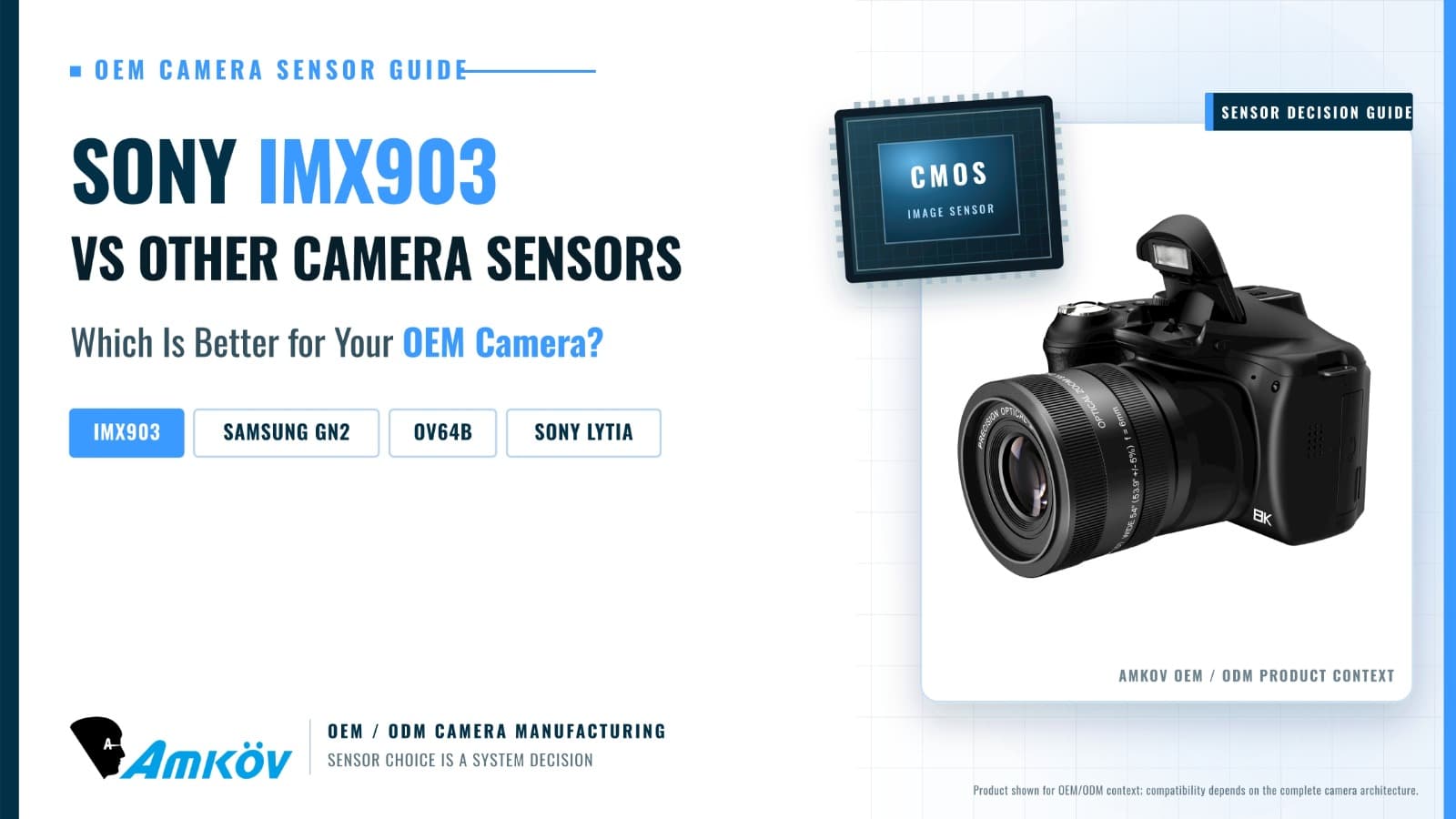
Choosing the right image sensor can shape the image quality, autofocus performance, video capability, power requirements and final cost of an OEM camera. But the sensor with the largest megapixel number is not automatically the best option. Camera brands should compare the sensor together with the processor, lens, firmware, thermal design, expected production volume and target retail price.
AMKOV has previously discussed the Sony IMX903 sensor in its analysis of the iPhone 16 Pro imaging system, highlighting the importance of faster sensor processing and the relationship between the sensor and processor rather than focusing on resolution alone. For OEM camera development, that same principle applies: the best sensor is the one that fits the complete camera platform.
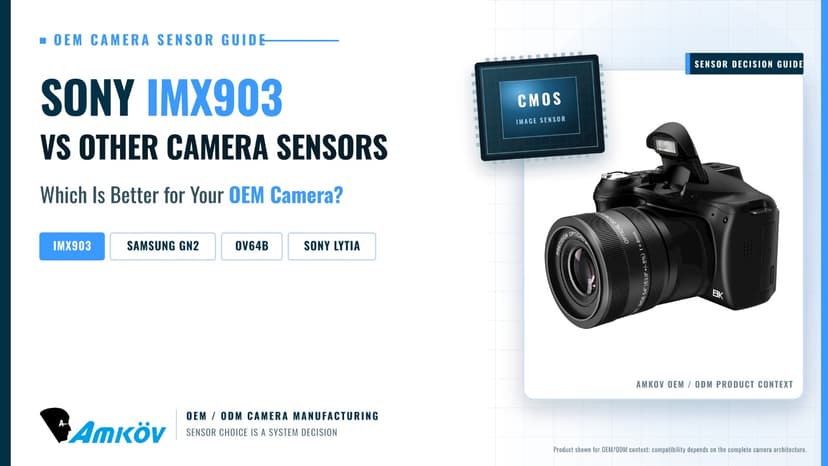
Sony IMX903, Samsung ISOCELL GN2, OmniVision OV64B, and Sony LYTIA sensors target different imaging priorities, so there is no single option that is best for every OEM camera. The right choice depends on the camera’s target market, image quality goals, autofocus requirements, video performance, product size, component availability, and total development cost. OEM buyers should therefore compare how each sensor fits the complete camera system rather than focusing only on megapixel count.
The Sony IMX903 sensor is an interesting option for performance-focused camera development where fast sensor processing and high-frame-rate video are important. AMKOV’s existing analysis of the IMX903 highlights its 48MP, 1/1.28-inch configuration and focuses particularly on faster communication between the sensor and image processor. This makes the IMX903 direction relevant for premium creator cameras, advanced video products, and OEM projects where processing speed and overall imaging-system integration are major priorities.
The Samsung ISOCELL GN2 takes a different approach with a 50MP sensor and relatively large 1.4µm pixels. Its strengths include Dual Pixel Pro autofocus, HDR technologies, and imaging capabilities designed for challenging lighting conditions. For OEM camera development, the GN2 can be worth considering when reliable autofocus, dynamic range, and light capture are more important than achieving the highest possible resolution.
The OmniVision OV64B provides 64MP resolution in a compact 1/2-inch optical format. It supports features such as phase-detection autofocus, 4K video at up to 60fps, and 8K recording at up to 30fps. Its combination of high resolution and smaller physical size can make it attractive for compact OEM camera modules where PCB space, module dimensions, and product size need to remain controlled. OV64B-based modules are also relatively accessible through component and module suppliers, which can be useful during early prototyping.
Sony’s LYTIA lineup represents a newer generation of CMOS imaging technology rather than one individual sensor. For comparison, a sensor such as the LYT-818 offers a 50MP, 1/1.28-inch format with 1.22µm pixels, all-pixel autofocus, improved dynamic range, low-noise imaging, and support for high-frame-rate 4K video. This makes Sony LYTIA particularly relevant for OEM cameras that need a balanced combination of image quality, autofocus, low-light performance, HDR, and video capability.
The Sony IMX903 is more relevant when high-speed processing and advanced video capability lead the product specification. The Samsung GN2 is worth considering when autofocus, HDR, and larger pixels are priorities. The OmniVision OV64B can suit projects requiring high resolution in a compact and potentially more accessible module format, while Sony LYTIA offers a balanced platform for low-light imaging, dynamic range, autofocus, and premium 4K video.
For OEM buyers, however, the final decision should also consider lens compatibility, ISP and processor requirements, firmware development, power consumption, thermal performance, sensor availability, MOQ, and total BOM cost. A sensor that looks strongest on paper is not necessarily the best choice unless it integrates efficiently into the finished camera.
For an OEM buyer, the Sony IMX903 is most useful as a reference for a performance-focused imaging architecture rather than simply as a 48MP sensor.
AMKOV's existing IMX903 analysis describes a 48MP, 1/1.28-inch sensor with a 1.22µm pixel pitch and emphasizes faster communication between the imaging sensor and processor. The article connects this faster imaging pipeline with capabilities such as 4K 120fps video and improved processing efficiency.
This makes the IMX903 discussion relevant to OEM projects targeting creator cameras, premium video products or other cameras where sensor readout and processor integration matter as much as headline resolution.
However, AMKOV currently discusses IMX903 in editorial content; the reviewed AMKOV product pages do not identify it as the installed sensor in a specific AMKOV retail camera. Therefore, availability, integration feasibility, pricing and MOQ for an IMX903-based OEM project should be confirmed during the specification and quotation stage. AMKOV publicly invites OEM/ODM and wholesale inquiries and describes its MOQ arrangements as flexible rather than publishing one fixed quantity for every project.
Best suited to consider when: the OEM project prioritizes high-speed image processing, advanced video capability and tight sensor-to-processor integration.
The Samsung ISOCELL GN2 takes a different approach. Samsung specifies it as a 50MP image sensor with relatively large 1.4µm pixels and emphasizes autofocus, HDR and low-light imaging capabilities.
One of its standout features is Dual Pixel Pro, which uses phase-detection information in multiple directions to improve autofocus. Samsung also highlights staggered HDR and Smart ISO Pro as important parts of the GN2 imaging architecture.
For an OEM camera, those characteristics make the GN2 particularly interesting where autofocus consistency, larger pixel dimensions and challenging-light performance have a higher priority than maximizing resolution.
The commercial question is less transparent. Samsung's public GN2 announcement provides technical information but does not provide a standard OEM sensor unit price or minimum order quantity. Those values therefore need to come from an authorized supplier or project quotation rather than being treated as fixed public numbers.
Best suited to consider when: autofocus performance, HDR and light capture are central product requirements.
The OmniVision OV64B offers the highest nominal resolution of these specific reference options at 64MP. OmniVision specifies a 1/2-inch optical format and 0.702µm pixels, making it a considerably more compact sensor architecture than the larger-format GN2 or LYT-818 reference.
Its technical capabilities include 64MP still capture, 4K video at up to 60fps, 8K at 30fps, staggered HDR and type-2 2×2 microlens phase-detection autofocus. It can also use pixel binning for 16MP output with greater effective sensitivity in lower light.
From an OEM perspective, OV64B is especially interesting where the design needs high resolution while keeping the camera module relatively compact.
It is also the comparison option for which current public module-level commercial information is easier to find. A referenced Alibaba listing shows a 64MP OV64B MIPI autofocus camera module at approximately $8.35–$13.50, with an MOQ of 5 pieces. This is useful as a prototyping-market reference only; it is not an official OmniVision bare-sensor price and not an AMKOV OEM quotation.
Best suited to consider when: compact module dimensions, 64MP resolution and flexible prototype sourcing are important.
Sony LYTIA is a sensor brand rather than one single competing sensor model. For a meaningful comparison, the LYT-818 is a useful reference because its specifications put it close to the high-end imaging class being discussed here.
Sony specifies the LYT-818 as a 50MP, 1/1.28-type CMOS image sensor with 1.22µm pixels. It is designed to reduce random noise and improve dynamic range, particularly in low-light and high-contrast scenes.
It also supports all-pixel autofocus and video modes up to 4K 120fps. These characteristics make the LYT-818 particularly relevant for products where HDR, low-light imaging, autofocus and high-frame-rate video need to work together.
Sony has continued expanding the LYTIA family. In 2026 it announced additional products such as the 64MP LYTIA 610 and the approximately 50MP LYTIA L910, showing that LYTIA should be evaluated as a current sensor platform rather than a single fixed specification.
Sony's public technical pages do not provide standard LYT-818 OEM unit pricing or MOQ. A buyer should therefore obtain a quotation based on sensor availability, volume and module requirements.
Best suited to consider when: low-light performance, HDR, autofocus and advanced 4K video are major priorities.
There is no single winner for every OEM camera.
Choose the IMX903 direction when fast processing and high-performance video architecture are central to the product concept.
Consider Samsung GN2 when larger pixels, autofocus and HDR performance carry more weight.
Consider OmniVision OV64B when the design needs high 64MP resolution in a smaller sensor format and easier access to module-level prototyping options.
Consider a Sony LYTIA platform such as LYT-818 when the target product needs a strong balance of low-light imaging, dynamic range, autofocus and 4K high-frame-rate video.
The final decision should be based on more than the sensor specification sheet. OEM buyers should also compare lens compatibility, ISP requirements, firmware development, thermal performance, battery consumption, module dimensions, supply stability, prototype results and total BOM cost.
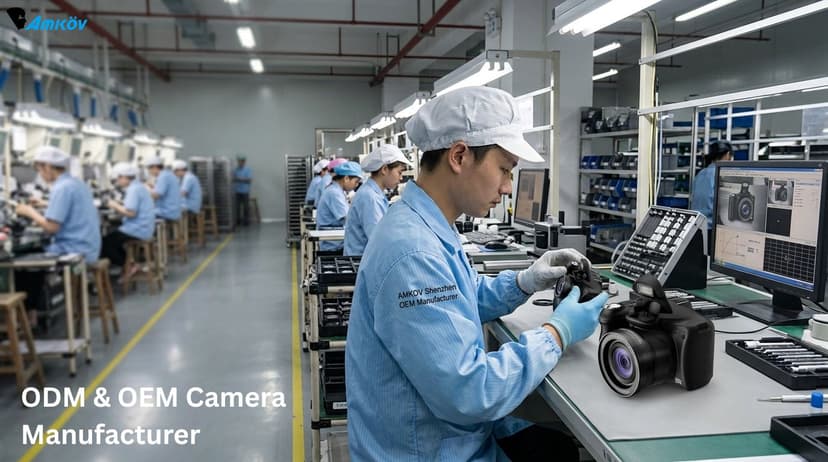
AMKOV provides OEM manufacturing, ODM development and bulk camera supply for international partners. Its current portfolio includes digital zoom, optical zoom, V-Log, waterproof, instant-print and other digital camera categories.
Instead of selecting a sensor in isolation, an OEM project can follow a complete development process:
Target Market → Product Specification → Sensor Selection → Lens & ISP Matching → Firmware → Prototype → Image Tuning → Testing → Mass Production
AMKOV's site currently promotes private-label and OEM/ODM camera projects with flexible MOQ and quotation-based wholesale pricing. This means the final price and MOQ should be established from the complete camera specification—not copied from a bare sensor or third-party module listing.
If your project is evaluating Sony IMX903, Samsung GN2, OmniVision OV64B, Sony LYTIA or another CMOS image sensor, send AMKOV your target resolution, video mode, autofocus requirements, lens configuration, estimated order quantity and target market.
Request Sensor Evaluation & OEM Pricing → www.amkov.com
The Sony IMX903 is a high-performance full-frame image sensor designed for professional imaging applications. It provides excellent image quality, high resolution, improved low-light performance, and advanced imaging capabilities for premium cameras.
Sony IMX903 offers advantages such as larger sensor size, improved light capture, higher image detail, better dynamic range, and professional-level image processing compared with many standard camera sensors.
Yes. Sony IMX903 is suitable for OEM camera manufacturers looking to develop premium digital cameras with advanced image quality, professional photography features, and competitive market positioning.
The best sensor depends on the camera purpose. Sony IMX903 provides higher performance for professional and premium cameras, while smaller sensors may be suitable for compact cameras requiring lower cost and simpler designs.
Key benefits include:
Yes. Using advanced sensors like Sony IMX903 can help OEM brands create cameras with better image quality, stronger product differentiation, and improved customer experience.
AMKOV manufactures OEM/ODM cameras — request our sensor spec sheet.
19/09/2026
05/09/2026
23/08/2026
10/08/2026
18/07/2026
01/07/2026
20/06/2026
06/06/2026
14/05/2026
22/04/2026